Digital Happiness

Author name: kane

Uncategorized

How New Digital Marketing Trends Drive Business Growth

Every year, digital marketing trends reshape the way brands find, engage, and convert customers — and 2026 is no exception. From AI-powered personalization to shoppable video, the businesses that adapt fastest to what’s new are the ones pulling ahead of their competitors. If you’re still relying on strategies from three years ago, you’re likely losing ground to competitors who’ve already moved on. In this guide, we’ll break down the trends actually driving results in 2026, and show you exactly how each one translates into real, measurable business growth. Why Digital Marketing Trends Matter for Business Growth Every shift in the marketing landscape reflects a shift in how real people search, browse, and buy. Ignore these changes, and your budget gets spent reaching an audience that has already moved on to newer platforms and formats. Follow them intelligently, and you unlock cheaper customer acquisition, stronger brand loyalty, and faster revenue growth. Consumers today expect personalized, fast, and authentic experiences from every brand they interact with. Businesses that track digital marketing trends closely can meet those expectations before their competitors do — and that head start compounds over time into a genuine competitive advantage. Top Digital Marketing Trends Shaping 2026 Let’s look at the specific trends driving results this year, and why each one deserves a place in your strategy. AI-Powered Personalization Artificial intelligence now sits at the center of nearly every high-performing marketing campaign. Instead of blasting the same message to an entire email list, AI tools analyze customer behavior in real time and generate tailored content, offers, and product recommendations for each segment — sometimes for each individual. Personalization is arguably the biggest of all current digital marketing trends because it directly affects revenue: consumers are significantly more likely to purchase from brands that deliver relevant, personalized content instead of generic messaging. For small and mid-sized businesses, this means AI-driven email flows, dynamic website content, and personalized retargeting ads are no longer optional extras — they’re baseline expectations. Growth impact: Higher conversion rates, better email open rates, and stronger customer retention. SEO: A Core Digital Marketing Trend in the AI Era SEO remains one of the most reliable growth channels for long-term, compounding results — but the rules have changed. AI-powered search results, answer engines, and voice assistants now summarize information before a user even clicks a link. This means your content needs to be structured, authoritative, and genuinely useful — not just keyword-stuffed. Businesses that invest in technical SEO, structured data, and high-quality content are showing up in both traditional search results and AI-generated answers, giving them two paths to visibility instead of one. Growth impact: Sustainable organic traffic, lower cost-per-acquisition compared to paid ads, and stronger domain authority over time. Short-Form and Shoppable Video Video consumption keeps climbing, and short-form, snackable content is winning attention across every platform. What’s new here is how quickly video is becoming transactional — shoppable video now lets viewers buy a product directly from a livestream or clip, turning passive viewing into an instant purchase. Connected TV (CTV) and streaming platforms are also emerging as serious performance channels, not just brand-awareness tools, giving businesses more places to convert attention into sales. Growth impact: Higher engagement rates, shorter paths to purchase, and better return on ad spend. Social Commerce and Community-Led Discovery More consumers now discover new brands through social content, creator recommendations, and online communities before ever typing a query into a search engine — using search mainly to validate a decision they’ve already started making. This is one of the more subtle but powerful shifts businesses need to plan around. Building an active social presence, partnering with relevant creators, and nurturing community engagement is now a discovery channel in its own right, not just a branding exercise. Growth impact: Wider top-of-funnel reach, improved brand trust, and new customer acquisition channels beyond paid search. Marketing Automation and Agentic AI Marketing automation has evolved well beyond scheduled emails. Agentic AI systems can now manage multi-step workflows — adjusting ad bids, testing creative variations, and optimizing campaigns with minimal manual input. Marketers are shifting from hands-on execution to strategic oversight, directing these systems rather than operating every lever themselves. This is one of the digital marketing trends with the biggest efficiency payoff: businesses can run more sophisticated campaigns without proportionally increasing their marketing headcount. Growth impact: Lower operational costs, faster campaign iteration, and more consistent performance across channels. Authentic, Human-Centered Content Strategy As AI-generated content floods the internet, authenticity has become a genuine competitive edge. Audiences are increasingly skeptical of polished, generic marketing and are gravitating toward brands that feel human, transparent, and trustworthy. This trend rewards businesses willing to show real people, real processes, and real results — case studies, behind-the-scenes content, and founder-led storytelling all perform strongly here. Growth impact: Stronger brand loyalty, higher engagement, and better word-of-mouth referrals. How to Turn Digital Marketing Trends into Business Growth Knowing the trends is only half the job — applying them strategically is what actually drives business growth. Here’s a practical approach Audit your current channels. Identify where you’re overinvesting in outdated tactics and underinvesting in emerging ones. Prioritize based on your audience. Not every trend fits every business; choose the two or three shifts most relevant to where your customers actually spend time. Test in small batches. Run limited pilots — a short video series, an AI-personalized email flow — before committing your full budget. Measure what matters. Track conversion rate, cost-per-acquisition, and customer lifetime value, not just impressions or likes. Iterate quickly. The pace of change in marketing today means last quarter’s winning formula can lose effectiveness fast, so build a culture of ongoing testing. Common Mistakes Businesses Make with New Digital Marketing Trends . FAQs About Digital Marketing Trends and Business Growth 1. What are the most important digital marketing trends for small businesses in 2026? AI-powered personalization, SEO built for AI-driven search, short-form video, and authentic content are the highest-impact trends for small businesses right now. These strategies improve online

Uncategorized

Ultimate Guide to Accelerate Your Website Performance by Web Booster | Digital Happiness

Published on July 2024 | Read Time: 8 minutes Web Booster: The Ultimate Guide to Accelerate Your Website Performance & Maximize SEO Rankings Discover how Web Booster services can transform your online presence, improve website speed, and drive organic traffic growth 🚀 Web Booster: Accelerate Your Digital Success 📋 Table of Contents Introduction to Web Booster Key Benefits of Web Booster Services Web Booster vs Traditional SEO How to Implement Web Booster Strategies Frequently Asked Questions Conclusion & Next Steps What is Web Booster? Understanding Website Performance Optimization In today’s fast-paced digital landscape, website speed and performance are no longer optional features—they’re essential requirements for success. Web Booster is a comprehensive optimization service designed to enhance your website’s performance, user experience, and search engine rankings simultaneously. 📌 Key Insight: Studies show that 53% of mobile users abandon sites that take longer than 3 seconds to load. Web Booster services directly address this critical issue. At Digital Happiness (marketmegood.in), our Web Booster service combines cutting-edge optimization techniques with proven SEO strategies to ensure your website performs at its best. Whether you’re running an eCommerce platform, a service-based business, or a content-heavy blog, Web Booster enhances every aspect of your digital presence. 💻 Professional Website Performance Optimization The Web Booster approach encompasses multiple optimization layers: from technical improvements and server optimization to content delivery and user experience enhancements. This holistic methodology ensures that your website not only ranks higher on search engines but also provides visitors with an exceptional browsing experience. 0.1s Average Load Time Improvement 45% Increase in Conversion Rates 75% Boost in Organic Traffic 89% Better User Experience Metrics Key Benefits of Web Booster for Your Online Business Investing in Web Booster services delivers tangible results across multiple dimensions of your digital presence. Here are the primary advantages that make Web Booster a game-changer for businesses of all sizes: ✅ Improved Page Load Speed Web Booster optimization significantly reduces your website’s load time, ensuring visitors have immediate access to your content. Faster loading times directly correlate with better user engagement and reduced bounce rates. ✅ Enhanced SEO Performance Search engines prioritize fast-loading websites. By implementing Web Booster techniques, you naturally improve your SEO ranking and visibility on search engine results pages (SERPs), driving more qualified organic traffic to your site. ✅ Superior User Experience A optimized website with improved performance metrics creates a seamless browsing experience. Users stay longer, explore more pages, and are more likely to convert into customers or subscribers. ✅ Increased Conversion Rates Faster websites convert better. Web Booster services directly impact your bottom line by reducing friction in the customer journey and eliminating performance-related barriers to purchase. 📊 Real Results from Web Booster Implementation Web Booster vs Traditional SEO: What’s the Difference? While traditional SEO services focus primarily on keyword optimization, link building, and content strategy, Web Booster takes a more comprehensive approach: Technical Performance Enhancement Web Booster focuses on the technical foundation of your website, including: Server Response Time Optimization: Ensuring your hosting infrastructure can handle traffic efficiently Image Optimization: Compressing and formatting images for faster delivery without quality loss Caching Strategies: Implementing browser and server-side caching to reduce load times Content Delivery Network (CDN): Distributing content across global servers for faster access Code Minification: Reducing CSS, JavaScript, and HTML file sizes Database Optimization: Streamlining queries and database performance These technical improvements complement your traditional SEO efforts, creating a synergistic effect that boosts both performance metrics and search rankings. 💡 Pro Tip: Combining Web Booster services with traditional Technical SEO strategies yields the best results. At Digital Happiness, we integrate both approaches for maximum impact. How to Implement Web Booster Strategies: A Step-by-Step Guide Implementing Web Booster optimization requires a systematic approach. Here’s how our optimization services work: Phase 1: Website Inspection & Audit We begin by conducting a detailed evaluation of your website’s current performance using industry-leading tools. This includes: Core Web Vitals assessment (Largest Contentful Paint, First Input Delay, Cumulative Layout Shift) Mobile and desktop performance analysis Speed testing across different geographic locations Technical SEO audit to identify optimization opportunities Next Steps: Based on the audit findings, we prioritize optimization opportunities that will deliver the greatest impact on your rankings and user experience. 🔍 Deep Performance Analysis & Optimization Phase 2: Deep Optimization Implementation Once we’ve identified opportunities, we implement comprehensive optimizations across multiple fronts: Infrastructure optimization (hosting, server configuration) Front-end performance enhancements Back-end database and query optimization Advanced caching implementation CDN setup and configuration Phase 3: Growth Analysis & Continuous Improvement Web Booster isn’t a one-time fix—it’s an ongoing process. We continuously monitor your website’s performance, analyze growth metrics, and implement refinements to ensure sustained improvements and compliance with evolving search engine algorithms. 🎯 Real-World Impact Our clients typically see page load time reductions of 40-60% within the first 30 days, leading to immediate improvements in bounce rates, time on site, and conversion metrics. Frequently Asked Questions About Web Booster ❓ How does Web Booster affect my SEO rankings? Web Booster directly impacts SEO through improved Core Web Vitals, which Google uses as ranking factors. Faster websites also have lower bounce rates, higher dwell time, and better user engagement signals—all factors that improve your SERP position. Our clients typically see 20-50% improvement in organic traffic within 2-3 months. ❓ How long does it take to see results from Web Booster optimization? You’ll notice immediate performance improvements—most sites see faster load times within days. However, SEO rankings typically improve within 4-8 weeks as search engines re-crawl and re-index your optimized pages. Sustained results continue to improve over 2-3 months as user engagement metrics improve. ❓ Is Web Booster suitable for eCommerce websites? Absolutely! eCommerce sites benefit tremendously from Web Booster optimization. Faster product pages lead to higher conversion rates, reduced cart abandonment, and improved customer satisfaction. We specialize in eCommerce optimization to maximize your sales potential. ❓ What if my website is already fast? Do I still need Web Booster? Even fast websites benefit from Web Booster optimization. Our approach identifies micro-optimizations

Uncategorized

Social Media Marketing in 2026: The Ultimate Guide to Growing Your Brand Online

Published by Digital Happiness | Your trusted partner for social media marketing, SEO, and digital growth Table of Contents Introduction In a world where your customers spend hours scrolling every single day, social media marketing is no longer optional; it’s the backbone of modern brand building. Whether you’re a small business owner in India or a growing eCommerce brand, a smart social media marketing strategy can turn casual followers into loyal, paying customers. At Digital Happiness, we specialize in helping brands like yours build a powerful online presence through data-backed social media management services. In this guide, we’ll break down everything you need to know to grow your business on social media in 2026 from strategy to execution to measurement. What Is Social Media Marketing? Social media marketing is the use of platforms like Instagram, Facebook, LinkedIn, X (Twitter), and YouTube to promote your brand, connect with your audience, and drive measurable business results, think traffic, leads, and sales. It combines content creation, community engagement, paid advertising, and analytics into one cohesive growth engine. Unlike traditional advertising, social media marketing is a two-way conversation. Brands that listen, respond, and adapt to their audience consistently outperform those that simply broadcast promotions. Why Social Media Marketing Matters for Your Business Here’s why every business regardless of size or industry | needs a solid presence on social media: If you’re also investing in Technical SEO or Local SEO, social media marketing amplifies those efforts by driving traffic and engagement signals search engines love. Core Elements of a Winning Social Media Marketing Strategy A results-driven social media marketing strategy typically includes: Choosing the Right Social Media Platforms Not every platform suits every business. Here’s a quick breakdown: Platform Best For Instagram Visual brands, eCommerce, lifestyle, fashion Facebook Local businesses, community building, older demographics LinkedIn B2B services, professional branding, recruitment YouTube Long-form storytelling, tutorials, product demos X (Twitter) Real-time updates, customer service, industry news Choosing the right mix depends on your audience and goals something our team maps out during every SEO Pricing and social strategy consultation. Content Ideas That Drive Engagement Struggling with what to post? Try these proven formats: Measuring Success: Social Media Analytics You can’t improve what you don’t measure. Track these key metrics monthly: At Digital Happiness, our reporting dashboards make it easy to see exactly how your social media marketing investment is performing check out real results in our Portfolio. Common Social Media Marketing Mistakes to Avoid How Digital Happiness Can Help At Digital Happiness, we don’t just post content we build social media marketing systems that grow your brand and your revenue. Our services include: Explore our full range of services on our Services page, learn more About Us, or browse real client results in our Portfolio. Social Media Marketing FAQs Frequently Asked Questions What does a social media marketing agency actually do? + A social media marketing agency plans, creates, and manages your content, paid advertising campaigns, and community engagement across multiple platforms. The goal is to increase brand awareness, attract qualified audiences, generate leads, and deliver measurable business growth. How often should I post on social media? + Most businesses achieve the best results by posting 3–5 times per week on platforms such as Instagram and Facebook, while maintaining daily engagement by responding to comments, messages, and customer inquiries. How long does it take to see results from social media marketing? + Organic social media growth typically begins showing noticeable improvements within 2–3 months. Paid social advertising, however, can generate website traffic, leads, and sales almost immediately after campaigns are launched. Which social media platform is best for my business? + The ideal platform depends on your target audience and business objectives. Instagram and Facebook are excellent for consumer-focused brands, while LinkedIn is highly effective for B2B companies and professional service providers. Do I need paid ads if I already post organically? + Yes. Combining organic content with paid advertising is the most effective strategy for sustainable growth. Paid campaigns help expand your reach beyond existing followers and accelerate lead generation and conversions. How much does social media management cost in India? + Social media management pricing depends on the number of platforms, content requirements, campaign complexity, and advertising budget. Contact Digital Happiness for a customized quote tailored to your business goals. Get Started Today Ready to turn your social media into a genuine growth channel? Let Digital Happiness build and manage a social media marketing strategy tailored to your brand. 👉 Get Your Free Social Media Audit Contact Us: 📧 Email: sam@marketmegood.in 📞 Phone: +91 78891 19179 🌐 Website: www.marketmegood.in Follow us on Facebook, Twitter, and YouTube for daily digital marketing tips.

Uncategorized

The Complete Guide to Ranking Your Business in Local Search (2026)

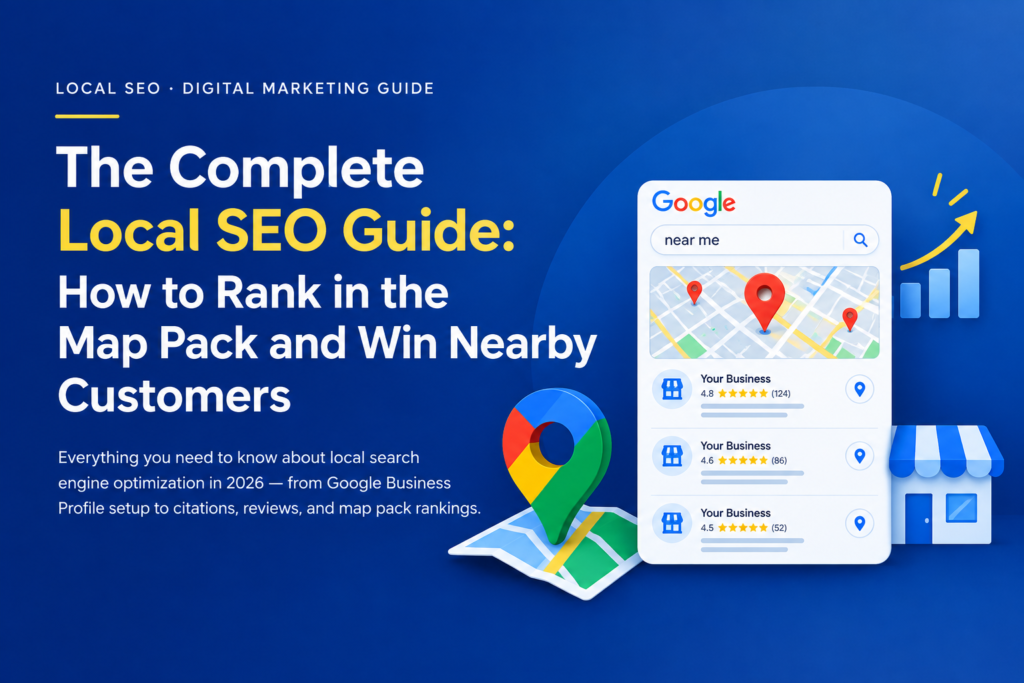
SEO Keyword Targeting Type Keywords Primary Keyword Local SEO Secondary Keywords Local SEO services, Local SEO for small business, Google Business Profile optimization, Local SEO India, Local SEO strategy, Local SEO ranking factors, Local SEO agency If you run a business that serves customers in a specific city or neighborhood, showing up when nearby customers search on Google is one of the highest-ROI things you can do for your brand. That’s exactly what Local SEO helps you achieve. In this guide, we’ll break down everything you need to know — what local SEO is, why it matters, and a step-by-step strategy you can start using today. At Digital Happiness, local SEO is one of our core SEO services, and this guide reflects the same strategies we use to help our clients rank higher in their local markets. Table of Contents What Is Local SEO? Local SEO is the practice of optimizing your online presence so your business appears in location-based search results — think “coffee shop near me,” “SEO agency in Patiala,” or “best dentist in Chandigarh.” Unlike traditional SEO, which focuses on ranking nationally or globally, local SEO focuses on visibility within a specific geographic radius. It touches three main areas of Google: Why “Near Me” Searches Matter Searches with “near me” or “close by” intent have grown dramatically over the past few years because most searches now happen on mobile devices with location services enabled. If your business isn’t optimized locally, you’re invisible to a huge chunk of ready-to-buy customers. Why Local SEO Matters for Your Business Local SEO isn’t optional anymore — it’s foundational for any business with a physical location or a defined service area. Higher Intent, Higher Conversions People searching locally are usually closer to making a purchase decision than someone browsing generic informational content. Free, Long-Term Visibility Unlike paid ads, a well-optimized local presence keeps generating traffic without an ongoing ad spend. Builds Trust Through Reviews and Proximity Customers naturally trust businesses that show up with strong reviews and a nearby location. If you’re unsure where your business currently stands, you can request a free audit from our team to see exactly where the gaps are. How Local Search Ranking Works Google’s local algorithm evaluates three primary signals: Relevance How well your business profile and website match what the searcher is looking for. Distance How close your business (or service area) is to the location used in the search. Prominence How well-known and reputable your business is, based on reviews, links, citations, and overall online authority. Understanding these three pillars helps you prioritize where to focus your efforts first. Key Local SEO Ranking Factors Google Business Profile Optimization Your Google Business Profile (GBP), formerly Google My Business, is the single most important local SEO asset you own. Core GBP Elements to Optimize Common GBP Errors NAP Consistency & Local Citations NAP stands for Name, Address, Phone number. Google cross-checks your NAP details across the web to verify legitimacy. Where to Build Citations Even small inconsistencies like “St.” vs “Street” can quietly hurt your rankings. Online Reviews & Reputation Reviews influence both rankings and click-through rates. Best Practices for Review Generation On-Page Local SEO Your website itself needs to reinforce your local relevance. Essential On-Page Elements Example of Local Schema Markup Adding structured data helps search engines clearly understand your business name, address, hours, and service area, which can improve your chances of appearing in rich local results. Local Link Building Backlinks from other local, relevant websites signal prominence to Google. Local Link-Building Ideas Step-by-Step Local SEO Strategy If this feels like a lot to manage alongside running your business, our team at Digital Happiness handles the entire process for you from technical SEO to citation building and review management. Common Local SEO Mistakes to Avoid Tools to Track Local SEO Performance Frequently Asked Questions 1. What is the difference between SEO and local SEO? Traditional SEO focuses on ranking a website broadly, often nationally or globally, while local SEO specifically targets visibility for location-based searches and Google’s local map results. 2. How long does local SEO take to show results? Most businesses start seeing measurable movement in 3 to 6 months, though competitive industries and locations may take longer to see significant results. 3. Do I need a physical storefront for local SEO? No. Service-area businesses without a public storefront can still rank locally by setting a defined service area on their Google Business Profile. 4. How important are Google reviews for local ranking? Very important. Review count, rating, and recency are all factored into Google’s prominence signal, which directly affects your local ranking. 5. What is NAP consistency and why does it matter? NAP stands for Name, Address, and Phone number. Keeping this information identical across your website and all directories helps Google trust your business’s legitimacy. 6. Can I do local SEO myself, or do I need an agency? You can absolutely start on your own using the steps in this guide, but an experienced agency can accelerate results and avoid costly mistakes, especially for competitive markets. 7. Does local SEO work for online-only businesses? Local SEO is most effective for businesses with a physical location or a defined service area. Purely online businesses typically benefit more from national or niche SEO strategies. 8. How often should I update my Google Business Profile? Regularly — ideally weekly with a new photo or post, and immediately whenever your hours, services, or contact details change. 9. What is a local citation? A local citation is any online mention of your business’s name, address, and phone number, typically found in directories, review sites, and industry listings. 10. How much does professional local SEO cost? Costs vary based on your industry, competition, and goals. You can request a free audit to get a clear, tailored estimate for you contact us. email – sam@marketmegood.in +91 78891 19179 +91 78891 19179

Uncategorized

Local SEO for Chiropractors

02 Local SEO for Chiropractors Local SEO for Chiropractors: The Foundation of Visibility Chiropractic care is a highly local service. Local SEO for chiropractors is where most practices should focus their first dollar. 1 Optimizing Your Google Business Profile Complete every field, categories, services, hours, and attributes Choose the most accurate primary category such as “Chiropractor” plus relevant secondary categories Upload real photos of your clinic, team, and treatment rooms, and update them regularly Post weekly updates, offers, or patient education content directly through your profile 2 NAP Consistency Across Directories Your Name, Address, and Phone number must match exactly across your website, Google Business Profile, Healthgrades, Yelp, and Zocdoc Inconsistent NAP data confuses search engines and quietly suppresses local rankings Audit and correct listings quarterly, especially after any office move or phone number change 3 Building Location Specific Landing Pages Practices with multiple clinics need a dedicated, uniquely written page per location, not one generic locations page Each page should include the specific address, an embedded map, local testimonials, and location specific service details Avoid duplicating content across location pages, since this dilutes rankings for all of them 4 Generating and Managing Patient Reviews Reviews are one of the strongest local ranking signals and a direct driver of patient trust Request reviews through a simple text or email sent right after the visit, while the experience is still fresh Respond to every review, positive and negative, promptly and personally Get a Local SEO Audit Talk to a Strategist Ready to own your local search results? We help chiropractic practices rank in the map pack, win more patient calls, and turn reviews into a steady stream of new bookings. Start Ranking Locally Explore Our Services www.digitalhappiness.in