Every year, digital marketing trends reshape the way brands find, engage, and convert customers — and 2026 is no exception. From AI-powered personalization to shoppable video, the businesses that adapt fastest to what’s new are the ones pulling ahead of their competitors. If you’re still relying on strategies from three years ago, you’re likely losing ground to competitors who’ve already moved on.
In this guide, we’ll break down the trends actually driving results in 2026, and show you exactly how each one translates into real, measurable business growth.
Why Digital Marketing Trends Matter for Business Growth
Every shift in the marketing landscape reflects a shift in how real people search, browse, and buy. Ignore these changes, and your budget gets spent reaching an audience that has already moved on to newer platforms and formats. Follow them intelligently, and you unlock cheaper customer acquisition, stronger brand loyalty, and faster revenue growth.
Consumers today expect personalized, fast, and authentic experiences from every brand they interact with. Businesses that track digital marketing trends closely can meet those expectations before their competitors do — and that head start compounds over time into a genuine competitive advantage.
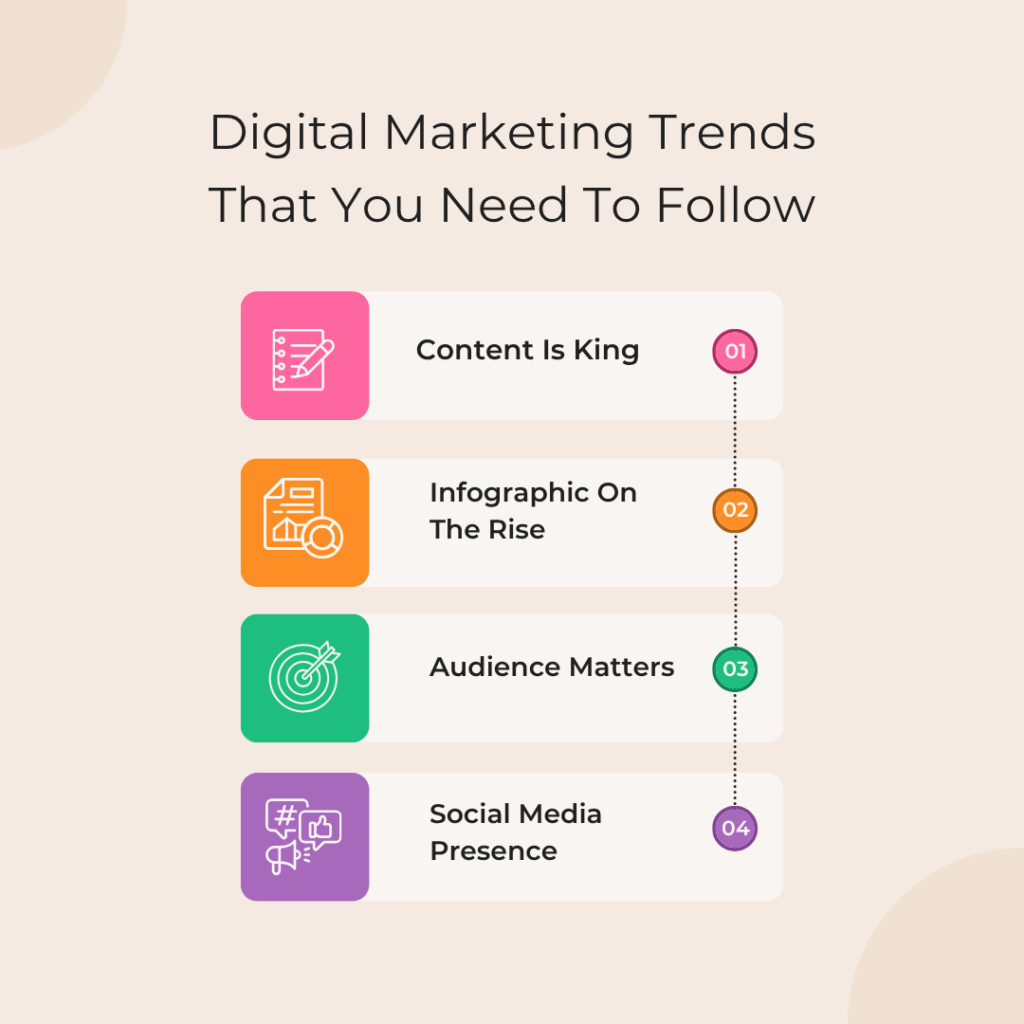
Top Digital Marketing Trends Shaping 2026
Let’s look at the specific trends driving results this year, and why each one deserves a place in your strategy.
AI-Powered Personalization
Artificial intelligence now sits at the center of nearly every high-performing marketing campaign. Instead of blasting the same message to an entire email list, AI tools analyze customer behavior in real time and generate tailored content, offers, and product recommendations for each segment — sometimes for each individual.
Personalization is arguably the biggest of all current digital marketing trends because it directly affects revenue: consumers are significantly more likely to purchase from brands that deliver relevant, personalized content instead of generic messaging. For small and mid-sized businesses, this means AI-driven email flows, dynamic website content, and personalized retargeting ads are no longer optional extras — they’re baseline expectations.
Growth impact: Higher conversion rates, better email open rates, and stronger customer retention.
SEO: A Core Digital Marketing Trend in the AI Era
SEO remains one of the most reliable growth channels for long-term, compounding results — but the rules have changed. AI-powered search results, answer engines, and voice assistants now summarize information before a user even clicks a link. This means your content needs to be structured, authoritative, and genuinely useful — not just keyword-stuffed.
Businesses that invest in technical SEO, structured data, and high-quality content are showing up in both traditional search results and AI-generated answers, giving them two paths to visibility instead of one.
Growth impact: Sustainable organic traffic, lower cost-per-acquisition compared to paid ads, and stronger domain authority over time.
Short-Form and Shoppable Video
Video consumption keeps climbing, and short-form, snackable content is winning attention across every platform. What’s new here is how quickly video is becoming transactional — shoppable video now lets viewers buy a product directly from a livestream or clip, turning passive viewing into an instant purchase.
Connected TV (CTV) and streaming platforms are also emerging as serious performance channels, not just brand-awareness tools, giving businesses more places to convert attention into sales.
Growth impact: Higher engagement rates, shorter paths to purchase, and better return on ad spend.
Social Commerce and Community-Led Discovery
More consumers now discover new brands through social content, creator recommendations, and online communities before ever typing a query into a search engine — using search mainly to validate a decision they’ve already started making. This is one of the more subtle but powerful shifts businesses need to plan around.
Building an active social presence, partnering with relevant creators, and nurturing community engagement is now a discovery channel in its own right, not just a branding exercise.
Growth impact: Wider top-of-funnel reach, improved brand trust, and new customer acquisition channels beyond paid search.
Marketing Automation and Agentic AI
Marketing automation has evolved well beyond scheduled emails. Agentic AI systems can now manage multi-step workflows — adjusting ad bids, testing creative variations, and optimizing campaigns with minimal manual input. Marketers are shifting from hands-on execution to strategic oversight, directing these systems rather than operating every lever themselves.
This is one of the digital marketing trends with the biggest efficiency payoff: businesses can run more sophisticated campaigns without proportionally increasing their marketing headcount.
Growth impact: Lower operational costs, faster campaign iteration, and more consistent performance across channels.
Authentic, Human-Centered Content Strategy
As AI-generated content floods the internet, authenticity has become a genuine competitive edge. Audiences are increasingly skeptical of polished, generic marketing and are gravitating toward brands that feel human, transparent, and trustworthy.
This trend rewards businesses willing to show real people, real processes, and real results — case studies, behind-the-scenes content, and founder-led storytelling all perform strongly here.
Growth impact: Stronger brand loyalty, higher engagement, and better word-of-mouth referrals.
How to Turn Digital Marketing Trends into Business Growth
Knowing the trends is only half the job — applying them strategically is what actually drives business growth. Here’s a practical approach
Audit your current channels. Identify where you’re overinvesting in outdated tactics and underinvesting in emerging ones.
Prioritize based on your audience. Not every trend fits every business; choose the two or three shifts most relevant to where your customers actually spend time.
Test in small batches. Run limited pilots — a short video series, an AI-personalized email flow — before committing your full budget.
Measure what matters. Track conversion rate, cost-per-acquisition, and customer lifetime value, not just impressions or likes.
Iterate quickly. The pace of change in marketing today means last quarter’s winning formula can lose effectiveness fast, so build a culture of ongoing testing.
Common Mistakes Businesses Make with New Digital Marketing Trends
- Chasing every trend at once, spreading budget too thin to see meaningful results from any single channel.
- Ignoring data in favor of copying what a competitor is doing, without checking if it fits their own audience.
- Treating AI tools as a replacement for strategy rather than a support system that still needs human direction.
- Neglecting SEO fundamentals while chasing flashier tactics like short-form video, even though solid SEO still drives the most consistent long-term traffic.
- Failing to track ROI, making it impossible to know which trends are actually worth the ongoing investment.
.
FAQs About Digital Marketing Trends and Business Growth
Ready to Put These Digital Marketing Trends to Work?
Staying on top of the marketing landscape is a full-time job — and applying it correctly is what separates real business growth from wasted ad spend. At Digital Happiness, we help businesses turn the latest digital marketing trends into practical strategies across SEO, content, social media, and paid campaigns.
👉 Get Your Free Digital Marketing Audit
Discover exactly where your current strategy stands — and which trends will move the needle for your business fastest.